



Hebrews 2:1–4 (WEB)
Therefore we ought to pay greater attention to the things that were heard, lest perhaps we drift away.
For if the word spoken through angels proved steadfast, and every transgression and disobedience received a just recompense,
how will we escape if we neglect so great a salvation— which at the first having been spoken through the Lord, was confirmed to us by those who heard,
God also bearing witness with them, both by signs and wonders, and by various miracles, and by gifts of the Holy Spirit, according to his own will?
The Danger of Spiritual Drift
The Call to Careful Attention
The warning in this passage grows directly out of what the writer has just established about Christ in the previous chapter. Because the Son is exalted above the angels and uniquely reveals God, the message that comes through Him carries unmatched authority. The opening word “therefore” connects the warning to that reality. Since the Son is greater than the angels, the response to His message must be correspondingly serious. For that reason the author urges his readers to “pay greater attention to the things that were heard” (Hebrews 2:1). The call is not simply to hear the gospel once, but to hold tightly to it with continued attentiveness.
The Danger of Spiritual Drift

Ship Adrift
The danger the author identifies is described with the image of drifting. The phrase “lest perhaps we drift away” (Hebrews 2:1) evokes the picture of something slowly carried off by a current. The movement is subtle and often unnoticed. A vessel tied loosely at the dock may appear secure for a time, but if the anchor is not firm it will gradually move farther and farther away from safety. In the same way, spiritual decline rarely begins with open rejection of Christ. It more often begins with neglect—less attention to the truth, less seriousness about the message that has been heard. Over time, this quiet neglect leads to distance from the very salvation that once seemed secure.
The Lesser-to-Greater Warning
The author strengthens the warning by appealing to a well-known principle from Israel’s history. “For if the word spoken through angels proved steadfast” (Hebrews 2:2), then every violation of that message received a just consequence. Jewish tradition often spoke of the law being delivered through angels. The point is not to diminish the law but to highlight its seriousness. God’s word mediated through angels was reliable and binding, and disobedience carried real judgment. Every act of transgression and disobedience was met with a just recompense.
If that was true of the law, the author asks a question that intensifies the argument: “How will we escape if we neglect so great a salvation?” (Hebrews 2:3). The reasoning moves from the lesser to the greater. If disobedience to a message delivered through angels brought judgment, how much more serious is neglecting the salvation announced by the Son Himself. The issue here is not merely open rebellion but neglect. To treat the message of Christ as something unimportant, something that can be ignored or postponed, is to place oneself in grave spiritual danger.
The Chain of Divine Testimony
The writer then reminds his readers that this salvation carries an extraordinary chain of testimony. First, it “was spoken through the Lord” (Hebrews 2:3). The message originates with Jesus Himself. The gospel is not speculation or human philosophy; it is the proclamation of the Son who came from the Father. After being spoken by the Lord, the message “was confirmed to us by those who heard” (Hebrews 2:3). The apostles and eyewitnesses passed on what they had received from Christ, faithfully testifying to His words and works.
Yet the testimony does not stop there. God Himself confirmed the message. The writer explains that God bore witness “by signs and wonders and by various miracles” (Hebrews 2:4). These miraculous works were not meant to stand alone as spectacles. They served as divine confirmation that the message about Christ was true. Alongside these miracles were “gifts of the Holy Spirit,” distributed according to God’s own will (Hebrews 2:4). Through these acts the Spirit validated the apostolic proclamation and demonstrated that the salvation announced in Christ came with God’s full authority.
The Pastoral Weight of the Warning
Taken together, the passage forms a pastoral warning rooted in Christ’s supremacy. The readers are not merely urged to avoid rebellion; they are called to remain attentive to the message they have received. Spiritual safety depends on continued attentiveness to the gospel. The writer wants his audience to recognize that drifting does not begin with dramatic rejection but with quiet neglect. Because the salvation proclaimed by Christ is so great and so thoroughly confirmed by God, it must be held with careful attention and reverent seriousness.
Visual Map of the Passage
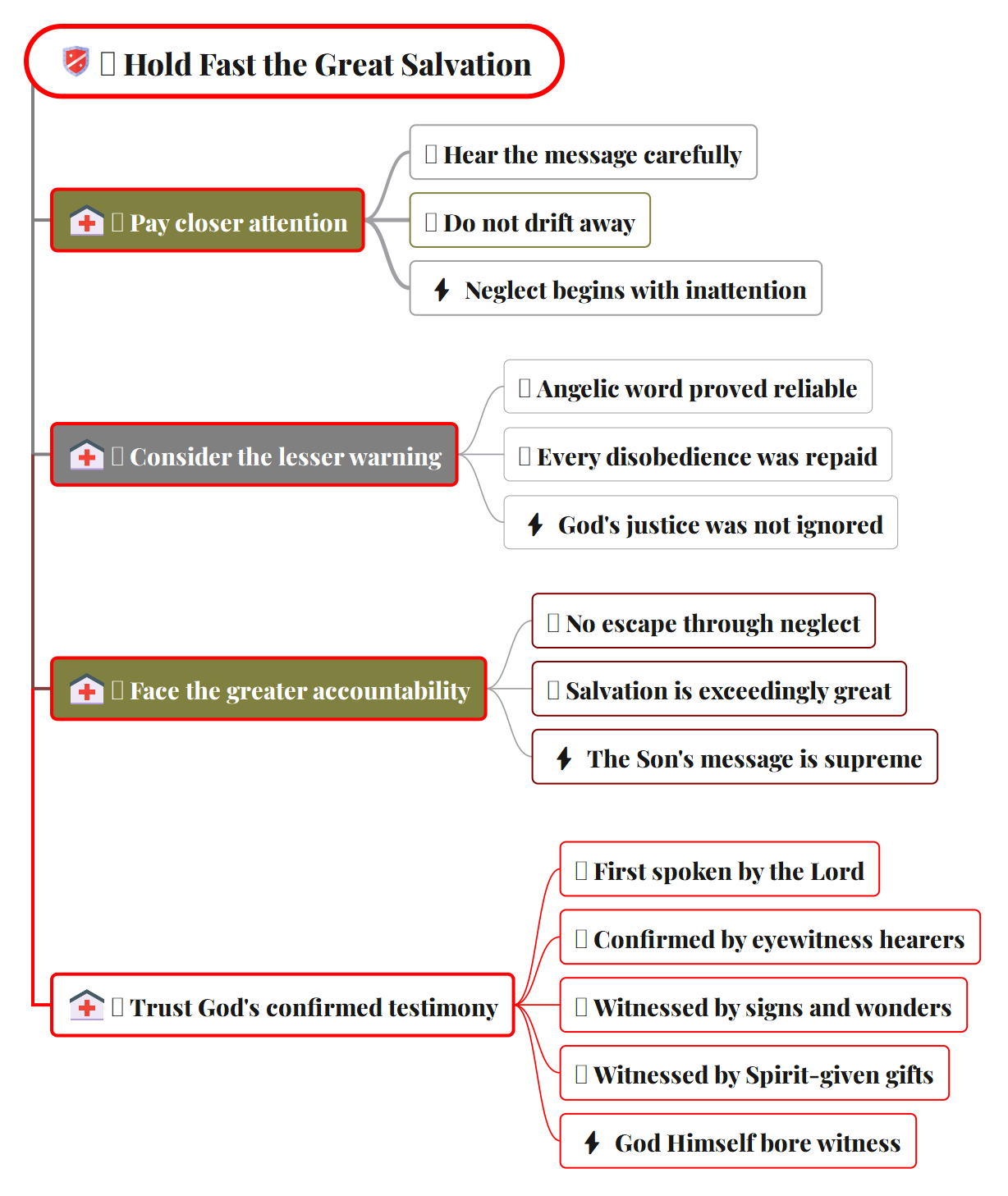
TAKE IT WITH YOU — TRUTHS TO REFLECT ON
The gospel must be held with careful attention.
Hebrews warns that spiritual danger often begins not with open rejection but with quiet neglect. Remaining anchored to Christ requires continual attentiveness to the truth we have heard.
Spiritual drift happens slowly and silently.
Like a vessel carried by the current, a believer can move away from truth gradually through inattention and complacency. Vigilance in faith is necessary because small compromises accumulate over time.
The salvation proclaimed by Christ carries ultimate authority.
If disobedience to the law delivered through angels brought judgment, the message spoken by the Son demands even greater reverence. The greatness of salvation magnifies the seriousness of neglecting it.
God Himself has confirmed the message of salvation.
The gospel was spoken by the Lord, affirmed by eyewitnesses, and confirmed by God through miracles and the gifts of the Holy Spirit. This layered testimony reminds believers that the message of Christ rests on divine authority.
True spiritual safety comes from remaining anchored to Christ.
The warning of Hebrews calls believers to remain attentive, steadfast, and rooted in the salvation they have received. Stability in the Christian life comes from continual attachment to the Son who revealed that salvation.
🏷️ #study_Hebrews_02, 🏷️ #study_Spiritual_Attention, 🏷️ #study_Great_Salvation, 🏷️ #study_Spiritual_Drift, 🏷️ #study_Divine_Testimony
Inspired By:
Allen, David L. Hebrews (Broadman & Holman, 2010), Kennard, Douglas W. A Biblical Theology of Hebrews (Wipf and Stock, 2018), Schreiner, Thomas R. Hebrews (Lexham Press, 2021), Peterson, David G. Hebrews: An Introduction and Commentary (IVP Academic, 2020), Spence-Jones, H. D. M., ed. Hebrews (Funk & Wagnalls Company, 1909), Farrar, F. W. In the Days of Thy Youth (Macmillan and Co., 1876), Exell, Joseph S. The Biblical Illustrator: Hebrews (James Nisbet & Co.)


